
 Kiny
Kiny
 Eng
Eng
 Fr
Fr




How Mrs. Nyirabahutu was developed by one cow that was given to her in the Girinka Munyarwanda
 Gisubizo Philemon
Apr 23, 2024 - 11:01
Gisubizo Philemon
Apr 23, 2024 - 11:01
It was in 2006 that the government of Rwanda launched the Girinka program to eradicate malnutrition, increasing agricultural production and modern breeding. It is a program that has brought many people out of poverty and placed them in the rich due to the good care of the cows they were given.
kwamamaza
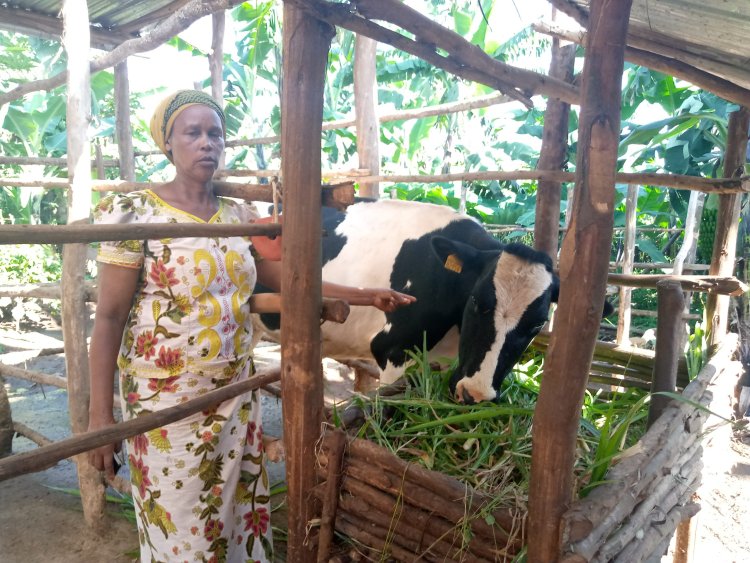
Mrs. Nyirabahutu Valantine, who lives in Isangano Village, Binunga Cell in Munyiginya Sector in Rwamagana District, is among those who have been promoted by this program. She is a 64-year-old woman with three children.
When you get home, you see that she is a rich lady who drinks milk, is blessed, and is kind to those who meet her. When you talk to her, she tells you that before she was given a cow, she had a bad life, she did not know how to drink milk, and she was supported by farming for the people, so she saw progress as something far away for her, but the government give her a cow so now she does not blame God.
In 2017, Nyirabahutu was included in the list of other vulnerable people who would be given cows by the partner of the Rwamagana District, Msaada. First, she is taught how to care about what cows will produce for her, she is ordered to plant grass and they also help her to build a good cow’s house that will make the manure in good condition.
Mrs. Nyirabahutu says that after a few days, she was given the cow, and she decided to devote a lot of time to it and make a lot of sacrifices to see if it would give her the desired result. This did not last long because as soon as she gave birth, she began to get the milk and sell it and her fields began to receive fertilizer and she bought another farm.
She said, "It gave birth and I sell it and add the money I get from the milk because it gives me 18 liters of milk a day. If I sell 15 liters, it is 200 Frw for my children to drink. Of the money I sold when it gave birth, I add the money I get from the milk and I buy a farm of 600 thousand sheep.”
She added, "When I bought that farm, the house I live in was made of bricks, and was about to fall. I sanded it and put cement in it. Now my house is in good condition, I have electricity and lighting so that it looks good, and I have a child who is studying in high school. I belong to many savings groups thanks to the cows.”
Mrs. Nyirabahutu says that she is currently encouraging other people who want to develop the farm to come visit her and teach them how to take care of cows properly.
She said, "Now the people around us are the ones who can tell you how I was before I saw it, I was a very poor woman but now I go to savings groups, I lend what I want and get it and pay, now at least I earn 3000 Frw from milk, I belong to many savings groups so it helps me pay it and I will be in cooperation so that I will never have a problem."
She went on to say that in the last cropping season, he collected ten bags of corn after planting and adding manure to this cow. "Now I take out a lot of compost and, now I eat bananas that I grow at home and it's better because of the compost."
Mrs. Nyirabahutu said that most get cows in the Girinka program and do not develop, it is often that they do not have a purpose and take care of the cows as they should, she confirmed that the progress she is seeing is that she has entered so that she can help other people who are in the same category as she used to be.
The Executive Secretary of Munyiginya Sector Niyomwungeri Richard, says that other people should learn from Nyirabahutu how to raise cows and develop them. He said that many people who receive cows feel that they develop them without taking care of them.
He said, "When you are given a cow, there are often those who think about how to sell it, others do not care about it, so they are the ones who cry that it is of no use to them, yet they care about it can develop them."
So far, more than 400,000 cows have been donated since 2006, and this program was initiated by President Kagame after realizing that there were a large number of children who were malnourished and many families who were in poverty.
kwamamaza