
 Kiny
Kiny
 Eng
Eng
 Fr
Fr








The Role of Men in Advancing Gender Equality in Agriculture
 Uwajeneza Donatha
May 3, 2024 - 19:15
Uwajeneza Donatha
May 3, 2024 - 19:15
Men's active involvement is crucial in promoting gender equality in agriculture. Their support is vital for creating an inclusive environment and ensuring women have equal access to resources and decision-making power. This happened to Twizerinama and Mrs. Uwamahoro’s family, who say that this is imperative for driving positive and sustainable change in the agricultural sector and economy.
kwamamaza
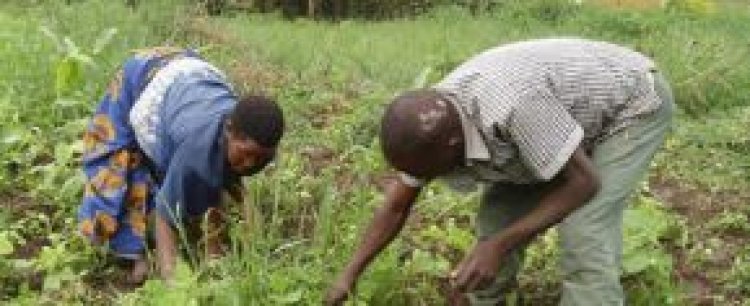
Twizerimana Emmanuel from the Rwamagana district in the Munyiginya sector stated that consulting as a farming community contributes to the development of the household. His wife, Mrs. Uwamahoro Jeannette, mentioned that it helped them in their relationship and expanded her mindset.
Twizerimana admitted he had earlier taken his family's property and neglected the rights of her wife. Now, they advise each other on what seeds to plant and how to use the produce they obtain.
"As farmers, we consult as a couple and discuss what needs to be done so we'll all be on the same page," he said.
”…whether it's beans, potatoes, or yams, we always agreed on what we're going to do. When we returned home, we would help each other. If my wife was going to harvest bananas, I would prepare firewood. Sometimes, when we got home, the man would wash up and go to the bar, leaving his wife to cook alone. He would return to find food ready on the table. But now that doesn't happen in our home," Twizerimana added.
Mrs. Uwamahoro expressed that not having the right to participate in agricultural production, and being excluded from it, brought her to be ashamed and made her feel like she was experiencing violence, which was the root cause of the conflict.
"When production came, my husband took all of it, even though we both cultivated. He can take it, control it and I didn't enter into it. He might come up with something but bringing it up without discussion, makes me feel useless. Not telling me the rest ...feels a shame...because you haven't been told everything to find out. When you don't know, that causes conflict,” she said.
She adds "But after teaching us, my husband came out of it, transformed, so when we got the production and he told me that we used these, then I felt that my heart was clean."
“We wouldn't go to the farm so that after planting, he wouldn't leave me alone! No! Then that indicates that a man is on top. If we farm, he helps me and plants the seeds. We would get home and talk about what to cook. I can cook, and she makes [meals] for us! (…) It makes us happy because we work together and understand each other and when it's like that, nothing can fail you" We would get home and talk about what to cook. I can cook, and she makes [meals] for us! (…) It makes us happy because we work together and understand each other and when it's like that, nothing can fail you, “she revealed.
Mrs. Uwamahoro confirms that before she was not involved in anything because everything was the man's, including making decisions at home. Using an example, she said that she once asked to rent a farm and they did so, and she offered another related to the use of the production.
"I told him that I have 20,000, I want us to rent a field so we can plant it. We agreed, and after getting a production, he said to me, 'What are we going to use this money for?' and I said 'You see we live with children in the house and they need their own house, let's build a house in the yard'. I said it and he understood that idea, he didn't hate it,” she highlighted.
She says that broadened his horizons. “I feel that I am there, we are two. I can't say that I gave this idea at home, because when he gets an idea, he brings it, and I do. And we work together to make it produced," she added.
When they lived in conflict, Twizeyimana says he did not accept his wife's idea, but because they now live in harmony and equality, there is no problem with it.
Mrs. Nareme Diane; the eldest daughter in the family says she dropped out of school because of a conflict between her parents. She just admits that her parents have transformed so much that they discuss everything, including the seeds at which they should farm.
He said, “When one says 'we are going to grow sweet potatoes', another says 'no! We are going to grow yams. Then you realize that they are not all together. They should sit down and discuss it, say 'We're all going to grow potatoes'. And my parents converse with us. Dad has changed a lot because they live well, we live in peace at home."
Twizerimana and Mrs. Uwamahoro believe that they educate their children this mutual work and mutual support is training for their children. They say they also converse with them on the principle of equality and harmony in the family. They also help other families living in conflict.
Mrs. Uwamahoro insists her husband's understanding of the principle of equality brought development into the family, as well as well-being.
“If you are not equal, there is no development. When you feel that a man and a woman are the same that complementarily produces a family's development and well-raised children, “she noticed.
kwamamaza